Data Types
JavaScript has 8 data-types, 7 primitives and Object
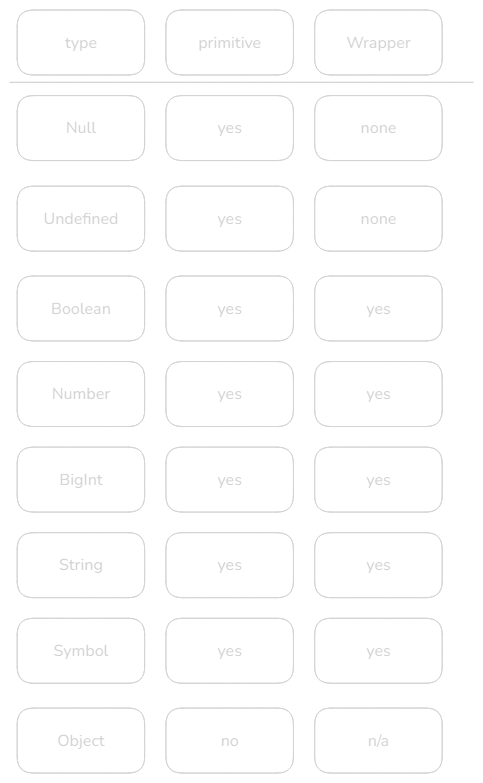
the 7 primitive types are immutable values.
They are Null, Undefined, Boolean, Number, BigInt, String, and Symbol
JavaScript uses Object wrapper classes, that are automatically used when operating with these primitive values. They expose functions that are very helpful for development
JS
Copy
let someString = "lars";
let someNumber = 12;

someString = someString.toUpperCase();
someNumber = someNumber.toExponential();

console.log(someString); // LARS
console.log(someNumber); // 1.2e+1
JavaScript is dynamically typed, which means a variable is not attached to a certain type, and can be reassigned any value.
JS
Copy
let someString = "lars";

someString = 12

console.log(typeof someString); // number
Type Coercion
JavaScript is also weakly typed, which means it'll try and convert a type to make an operation happen.
This is called type coercion, and can for example happen when trying to add a Number with a String
JS
Copy
let someNumber = 10;
let someString = "Lars"
let combined =  someString + someNumber;

console.log(typeof combined) // string
console.log(combined)        // Lars10
here the Number variable is converted to a string (coerced)
It's often not a good idea to rely on implicit type coercion.
Therefore it's recommended to use explicit conversions, and use the triple '===' comparision operator
JS
Copy
if (2 == "2") {
    console.log("Works, because '==' uses type coercion")
}

if (2 === "2") {
    console.log("Does not work, because it does not coerce the type.")
}
// Works, because '==' uses type coercion
As one can see from the code snippet above, the first check actually fires, because it'll convert the number to a string
this can lead to unexpected behaviour.